
Doping in track and field is a big challenge. We have closely examined data from the Athletics Integrity Unit (AIU) and the World Anti-Doping Agency (WADA) over the past five years. This analysis shows some clear trends in drug violations across different countries and substances.
Where Doping is Most Common: Country by Country
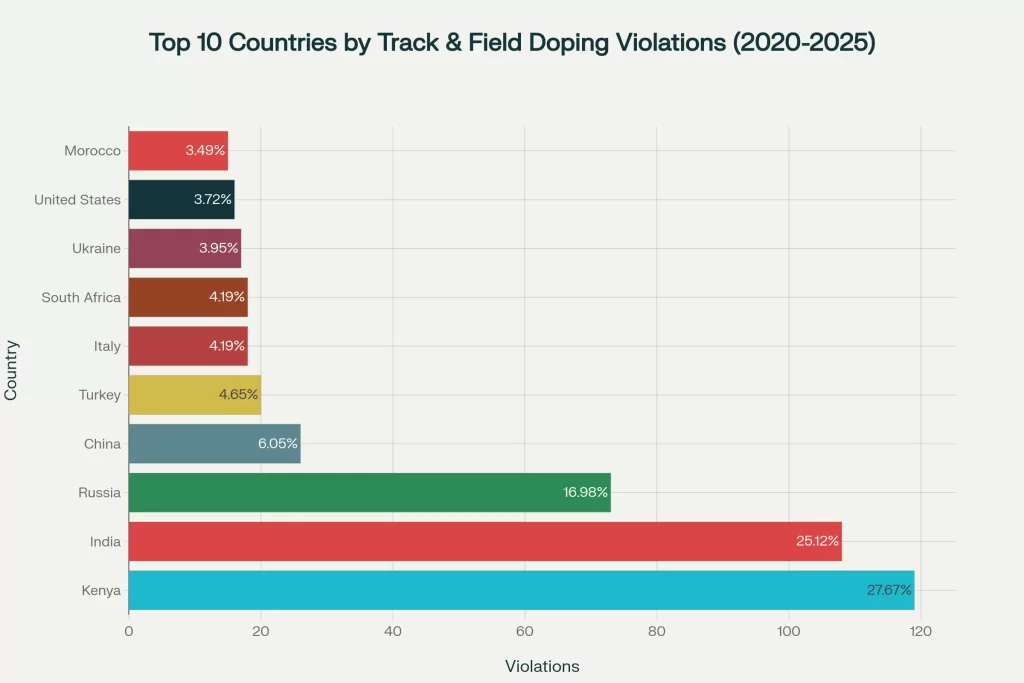
When it comes to the number of athletes currently banned for doping, a few countries stand out:
- Kenya leads globally with 119 athletes banned. That’s nearly a quarter (24.7%) of all track and field cases.
- India is next with 108 violations (22.5%).
- Russia follows with 73 cases (15.2%).
These three countries alone make up almost two-thirds (61.9%) of all current doping violations in athletics worldwide. It’s worth noting that 199 of World Athletics’ 214 member federations have no athletes on the current ban list. This means the problem is really concentrated in a small number of places.
Here’s a look at the top countries:
| Rank | Country | Total Violations | Percentage | Region |
|---|---|---|---|---|
| 1 | Kenya | 119 | 24.74% | Africa |
| 2 | India | 108 | 22.45% | Asia |
| 3 | Russia | 73 | 15.18% | Europe |
| 4 | China | 26 | 5.40% | Asia |
| 5 | Turkey | 20 | 4.16% | Europe |
| 6 | Italy | 18 | 3.74% | Europe |
| 7 | South Africa | 18 | 3.74% | Africa |
| 8 | Ukraine | 17 | 3.53% | Europe |
| 9 | United States | 16 | 3.33% | North America |
| 10 | Morocco | 15 | 3.12% | Africa |
Regional Doping Breakdown

Looking at regions, Africa has the most violations with 176 cases (36.5%). Kenya’s high numbers contribute a lot to this. Asia is second with 144 violations (29.8%), mainly due to India. Europe accounts for 129 violations (26.7%). North America, South America, and Oceania have very small percentages.
- Africa: 176 violations (36.5%) – Kenya, Morocco, Ethiopia are leading.
- Asia: 144 violations (29.8%) – India, China, Kuwait are main contributors.
- Europe: 129 violations (26.7%) – Russia, Turkey, Italy are most affected.
- North America: 16 violations (3.3%) – The United States is the only notable contributor.
- South America: 8 violations (1.7%)
- Oceania: 2 violations (0.4%)
The Substances Athletes Use
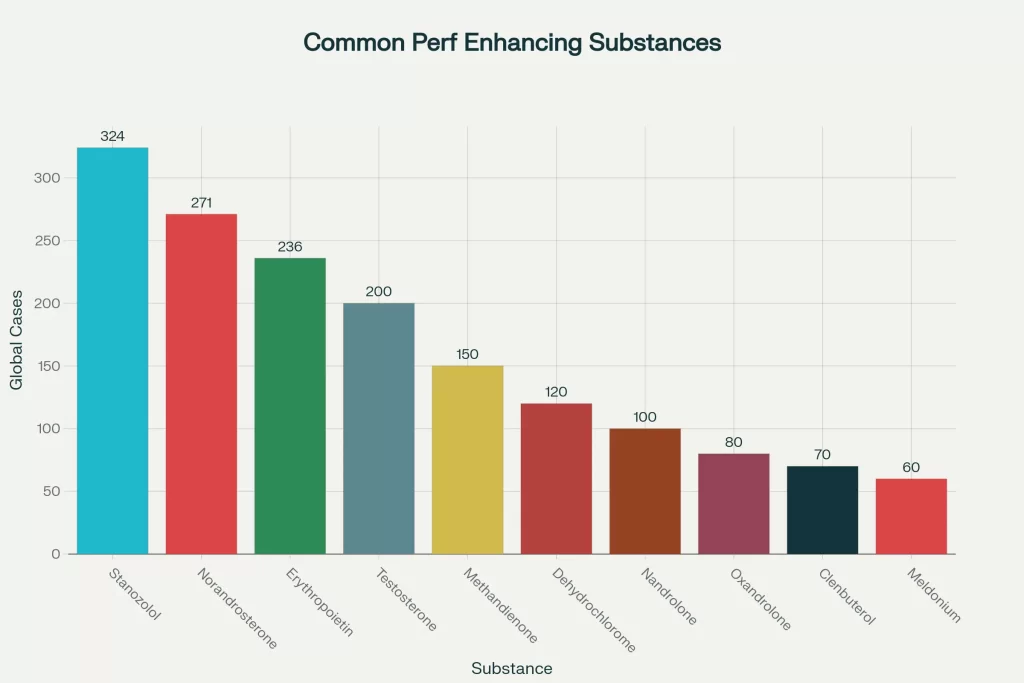
Anabolic steroids are by far the most common doping substances in track and field, making up about 65% of all violations.
Stanozolol is the most detected substance globally, with 324 confirmed cases.
Norandrosterone is next with 271 cases.
EPO follows with 236 cases.
Here’s a quick look at the most common substances:
| Substance | Total Cases | Type | Primary Effects |
|---|---|---|---|
| Stanozolol | 324 | Anabolic Steroid | Muscle mass, strength |
| Norandrosterone | 271 | Steroid Metabolite | Muscle growth, recovery |
| EPO | 236 | Hormone | Oxygen delivery, endurance |
| Testosterone | 200 | Anabolic Steroid | Muscle mass, strength |
| Methandienone | 150 | Anabolic Steroid | Rapid muscle growth |
Some countries also show distinct preferences for certain substances:
- Kenya: Norandrosterone is dominant, making up 94 of their 97 total cases (32% of all Kenyan violations).
- India: Stanozolol leads with 80 cases, plus 137 norandrosterone violations.
- Russia: Dehydrochloromethyltestosterone (Oral Turinabol) is preferred with 62 cases.
- United States: Testosterone is the most common with 50 cases.
- China: Stanozolol and clenbuterol are frequently detected.
Doping by Event Type
When we look at which events have the most doping cases, a few categories stand out from recent sanction records:
- Long Distance (3,000m and above): 32% of cases
- Sprints (400m or less): 24% of cases
- Jumps: 12% of cases
- Javelin: 8% of cases
- Middle Distance (800m–1,500m): 8% of cases
- Hammer: 8% of cases
- Steeplechase (3,000m SC): 4% of cases
This means endurance events (long distance and steeplechase) see the most doping, followed closely by short sprints. Jumps and throws (like javelin and hammer) also have a significant number of cases. This trend makes sense, as these events rely heavily on speed, endurance, and power, which banned substances can boost.
Doping Trends Over Time
The number of doping violations has gone up in recent years. WADA data shows athletics violations increased from 147 in 2021 to 201 in 2022. The AIU Global Ineligibility List for 2024-2025 has 481 currently banned individuals, the highest number ever recorded.
Key trends:
- 2021: Russia had the most athletics violations with 96.
- 2022: India was at the top with 48 athletics violations, while Kenya had 54.
- 2024-2025: Kenya now leads with 119 total current bans.
Testing has also increased a lot. The AIU did over 13,000 tests in 2024, with 64.5% of those being out-of-competition tests. For the Paris 2024 Olympics, 97% of medallists were in AIU testing pools, and all medallists had at least one out-of-competition test.
Impact on Big Competitions
Keeping major events like the Olympics and World Championships clean is a top priority. At the Paris 2024 Olympics, only one positive doping test was reported in athletics during the Games themselves. However, more than 40 doping violations were found among athletes expected to participate in the period leading up to the Games.
The AIU handled 100 international cases in 2024. This included stopping elite athletes like Lawrence Cherono, Rogers Kwemoi, and Rhonex Kipruto from competing, which helped keep the Olympic competition fair.
Key Takeaways
- The doping problem in track and field is very concentrated. Just three countries are responsible for almost two-thirds of all current violations.
- Kenya is a major concern, leading in both athletic success and doping cases. They have a particularly high rate of norandrosterone use in distance running.
- Anabolic steroids, especially stanozolol and norandrosterone, are the most common substances used. Their use patterns vary by region and event.
- The AIU’s efforts with increased testing and education programs are showing results, especially around major competitions. But because violations are still heavily concentrated in specific countries, more focused actions are needed to address why athletes in these regions are using performance-enhancing drugs.
Sources Used
| Source | Organization | Focus | Direct Link |
|---|---|---|---|
| Global List of Ineligible Persons | Athletics Integrity Unit (World Athletics) | Official list of currently banned athletes, event breakdowns, and countries | AIU Ineligible List |
| WADA Annual Reports | World Anti-Doping Agency | Annual global statistics, trends, and compliance data | WADA 2022 Annual Report |
| Olympic Anti-Doping Program (Paris 2024 summary) | International Testing Agency (Olympics/ITA) | Major event testing volume and summary, targeted program findings | ITA Paris 2024 Anti-Doping Program |
| Notifications and Sanctions Overview | Athletics Integrity Unit (World Athletics) | Case outcomes by event, athlete, and country | AIU Notifications & Sanctions |